
July 1, 2026
How Precog Rebuilt Customer Support with Agentic AI
Joseph Arnold

For Precog, scaling the support team is a high-stakes challenge with a tangible impact to the business. The ticket volume increases with a growing customer base. The headcount doesn't.
"Part of the problem was quickly triaging and organizing these tickets into tasks for our support engineers to perform," says Matt, who leads customer support at Precog. "This is a gap that we've now filled with agentic AI."
What his team built, with Precog's context engine for AI providing the foundation, closed that gap: faster issue resolution, more capacity from the same team, and measurably better retention. Here's how it works.
The System
The current Precog support system has three parts, each handled by a dedicated AI agent that runs hourly.
Stage 1: Triage. When a support ticket comes into Intercom (whether by email or through the in-app chat), a human does an initial, brief read to provide a first pass. From there, an AI triage agent takes over: categorizing the ticket, assessing the customer's situation, and determining priority and assignment.
Stage 2: Deduplication. Before any new ticket gets turned into a work item, a second agent checks it against the existing workload in Linear, Precog's work management tool. Without it, any open customer ticket would generate a new Linear work item on every run. The same issue, duplicated hourly.
Stage 3: Diagnosis. The third agent, a coding agent, analyzes the issue and provides support engineers with a first-pass diagnosis before they touch the ticket. That diagnosis is grounded in product context (logs from Supabase, MongoDB, and Datadog) alongside customer context like subscription and contract entitlements.
By the time a support engineer touches an open ticket, the grunt work is done. The ticket is categorized, deduplicated, and comes with a diagnostic head start.
How Precog's Context Engine Makes the Agents Work
The obvious question is: these tools all have MCP servers and APIs: why not connect to them directly?
Matt's team tried that first. It didn't hold up well.
Connecting AI agents directly to Intercom's native MCP server produced an integration that worked sometimes and failed unpredictably. "We were having problems with our agents missing tickets because it wasn't able to effectively retrieve the data from Intercom," Matt explains. And for a business-critical workflow that handles real customer issues, regular agent failure is unacceptable.
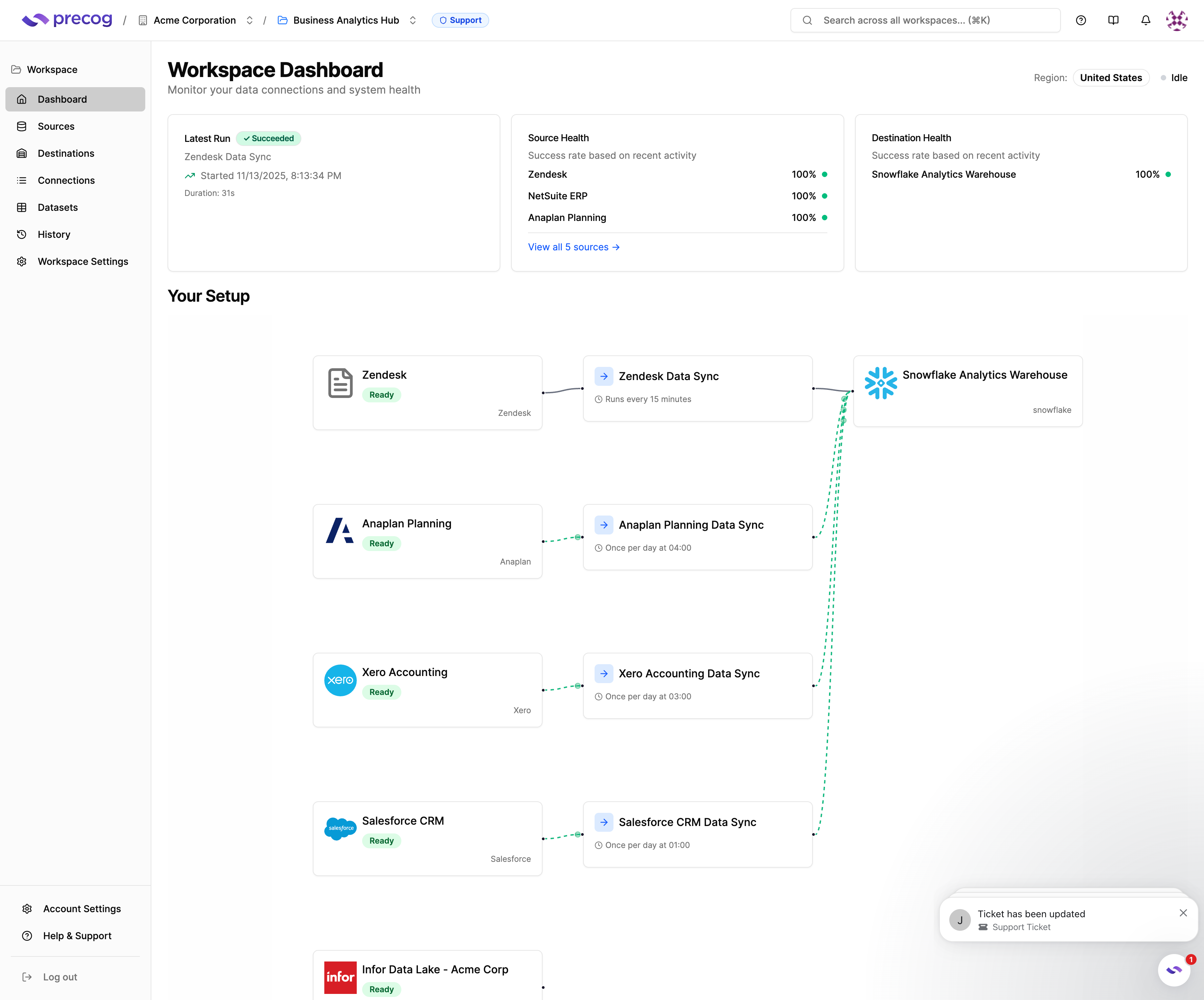
Connecting directly to source systems floods the AI's context window, driving up token costs, degrading output quality, and ultimately causing the kind of reliability challenges Matt's team ran into. The fix: use Precog's context layer to bring data from all applications into Snowflake, infused with a semantic model that understands business definitions and logic, so agents query only what's relevant.
Agents That Get Better Over Time
Good support processes require ongoing refinement: what works today may not work as the team grows, the product changes, or the customer base shifts. Balancing ticket priority, matching issues to the right engineer, knowing when something is urgent and when it isn't. These are judgment calls that don't conform to simple rules and take iteration to get right.
Precog's knowledge base makes that iteration possible: a persistent layer of feedback and business context that agents draw on regardless of which team member they're working with. Over time, the system builds a deeper understanding of how Precog's support operation works, not just for one person, but for the whole team. When an engineer gives feedback on outputs, the agent stores that feedback directly to the model knowledge base.
"Our agents have performance reviews just like our employees do," he says.
The agentic workflow that runs today is meaningfully better. The model gets sharper with every round of feedback, building a deeper understanding of the business through real-time input from the team.
The Outcome
Matt is direct about the impact: faster resolutions, happier customers, and a renewal rate that reflects it.
The team is still small. What changed is their capacity: triage, deduplication, and diagnosis happen automatically, so engineers focus on solving problems.
"The business impact of having these robust agentic AI pipelines," Matt says, "is that it allows us to really 10x each of our support engineers."
Try Precog Free
The most productive AI-assisted teams are the ones with data that's accessible, contextual, and deeply understood. Start your free trial today and see how quickly you can build AI pilots powered by your own data.


.svg)


