
June 9, 2026
5 Questions Manufacturing CFOs Should Be Asking About Operational Data
Ethan Maxfield

Manufacturing finance leaders are under growing pressure to explain not just the numbers, but the story behind them: why costs moved, where margin pressure is building, which products or suppliers are driving the change, and what the business should do next.
That's harder than it sounds. The data needed to answer those questions is spread across ERP platforms like SAP S/4HANA or Oracle, procurement tools like SAP Ariba or Coupa, and a range of other critical applications covering supply chain, inventory, service, and customer operations.
The result: finance teams can usually tell you what happened. Getting to why it happened means waiting on manual exports, spreadsheet reconciliation, or a request to the data team. By the time an answer comes back, it can be weeks later, decisions have already been made, and the moment to act has passed.
Here are five questions manufacturing CFOs should be asking to close that gap.
1. Can we quickly explain why costs changed?
Most finance teams can eventually report that costs increased. The harder question is why.
Which suppliers contributed to the increase? Which products became more expensive to support? Which service, repair, or warranty categories are escalating? Which departments, regions, or customer segments are creating margin pressure?
In manufacturing, cost movement rarely comes from one place. It can trace back to procurement, supplier performance, inventory, production, service, logistics, labor, or customer operations, often several at once.
When the answer takes weeks to surface, margin pressure compounds before anyone has a clear picture of where to focus. By the time the analysis is ready, the window to course-correct may already be closing.
The goal isn't to report cost changes after they happen. It's to identify the operational drivers early enough to actually do something about it.
2. Do we know which operational systems hold the data finance needs?
The challenge is that there is no single place to look. The data finance needs is spread across ERP, procurement, service, supply chain, inventory, and customer systems. And each of those has its own owner, its own structure, and its own process for getting data out of it.
A few questions to consider:
- Which systems hold the data we need to explain cost and margin movement?
- Is the data available in the environments where analysis actually happens?
- Who owns the process when finance needs a new operational data source?
- How long does it take to make that data usable?
If the answer is unclear, you may be operating with only a partial view of the business. Today's finance teams need more than access to financial data. They need reliable access to the operational data behind the numbers.
3. How much reporting still depends on manual work?
Manual reporting creates hidden cost. Every export, spreadsheet, reconciliation, and one-off data pull is time that could be spent on what actually moves the business forward: accelerating month-end close, identifying opportunities to reduce costs, or providing the forward-looking analysis leadership is asking for.
For many manufacturing finance teams, the issue is not a lack of effort. It is that the process for getting usable data is too dependent on people manually stitching information together.
Some questions worth asking:
- How much time do analysts spend preparing data versus interpreting it?
- How many recurring reports depend on spreadsheet workarounds?
- How many business questions require IT or data team support?
- How often do different teams arrive at different answers?
When manual work is the bridge between operational systems and financial analysis, teams spend more time building the answer than acting on it.
4. When leadership asks what AI can do for finance, do we have an answer?
Most finance leaders are getting some version of the same directive from the board or executive team: find ways to use AI. The appeal is real. If someone could ask a question in plain language and get back an accurate, auditable answer in seconds, the implications for finance are significant. Faster board prep, quicker responses to ad hoc requests, less dependence on the data team.
But most AI pilots in finance stall or fail. And the reason is rarely the AI itself. It is the data underneath it.
AI tools are only as reliable as the context behind the data they can access. Without an understanding of how your business defines cost, margin, or performance, which systems hold which numbers, how they relate to each other, and what your terminology actually means, AI cannot give you answers you can trust or act on.
Start by asking:
- What would it actually take for our team to get reliable answers from AI?
- Can we get accurate answers to ad hoc questions without waiting on the data team?
- Do we have the right operational data in place for AI to return answers we could defend?
- If an AI tool gave us an answer today, could we trace where it came from?
The pressure to show progress on AI is real. But speed without a reliable data foundation does not produce results. It produces failed pilots and lost confidence.
5. Can finance answer new business questions without starting a new data project?
The business changes constantly. New products, new suppliers, new service issues, new customer demands, new margin pressures, new reporting needs. Finance cannot afford to treat every new question like a new data project.
When every new analysis requires a fresh export, a new spreadsheet model, an IT ticket, or a custom pipeline, finance becomes slower than the business it is trying to support.
Finance leaders should ask:
- How quickly can we investigate a new cost or margin question?
- Can we access the data we need without starting from scratch?
- Can we combine financial and operational data without heavy manual effort?
- Can we move from question to answer fast enough to influence decisions?
The best finance teams are not just improving reporting. They are improving the way operational data becomes usable for decisions. That is the difference between explaining what happened and helping the business decide what to do next.
The data foundation determines whether AI works for finance
Most finance teams understand the impact AI can add to their work. What slows them down is access to the right data, with the right context, fast enough to matter.
That is what determines whether AI delivers on its promise for finance or becomes another failed pilot. Not the model, not the interface, but whether the underlying data is connected, understood, and ready to answer the questions the business is actually asking.
The question is no longer whether AI can help finance move faster. The question is whether your data is set up to make that possible.
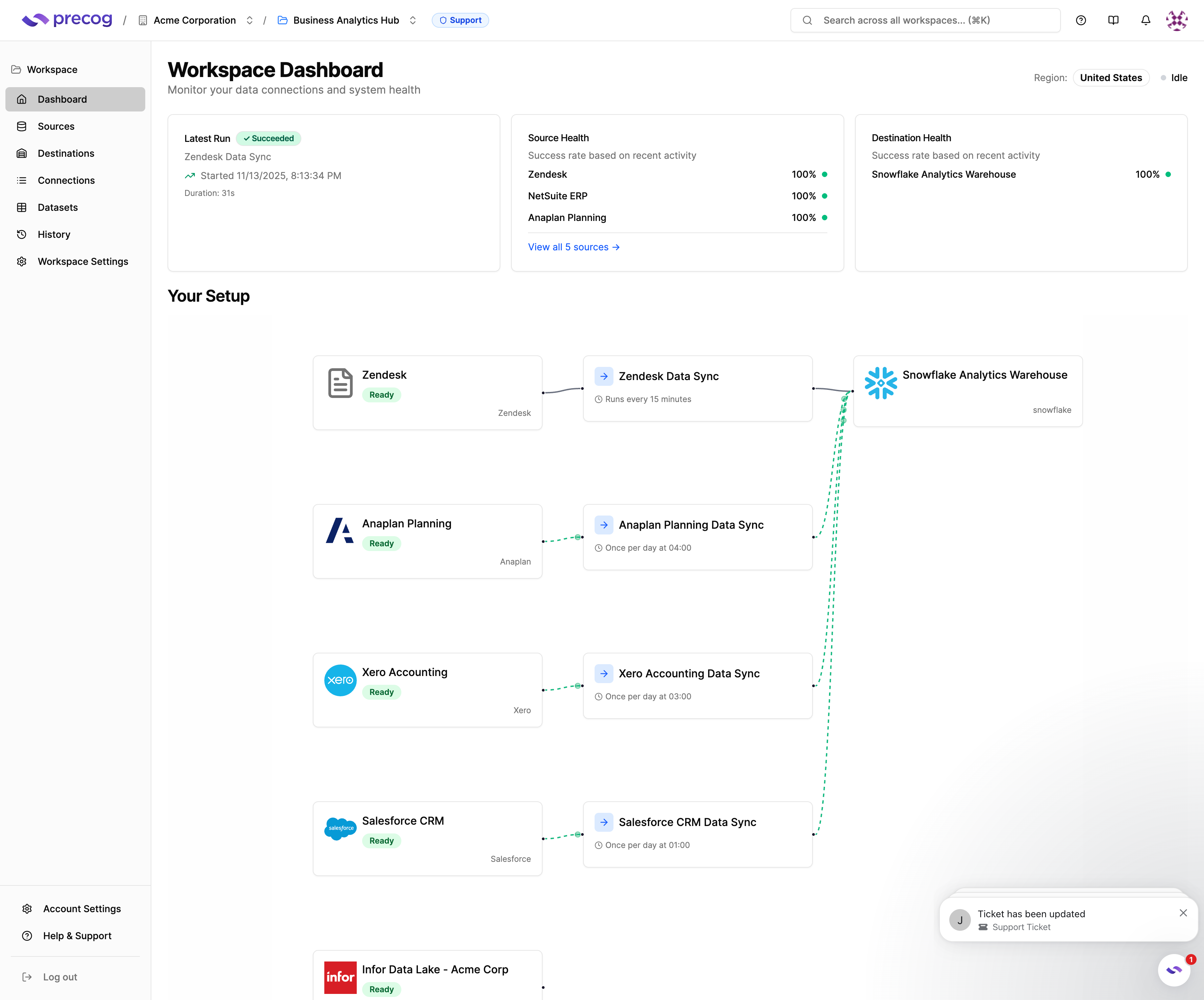
Precog helps manufacturing finance teams get accurate, trustworthy answers from their business data using their company's AI tools, without waiting on the data team.


.svg)


